
AI Matching: The First Steps Toward Smarter Candidate Search
A Brief History of Matching in Talent Catalog
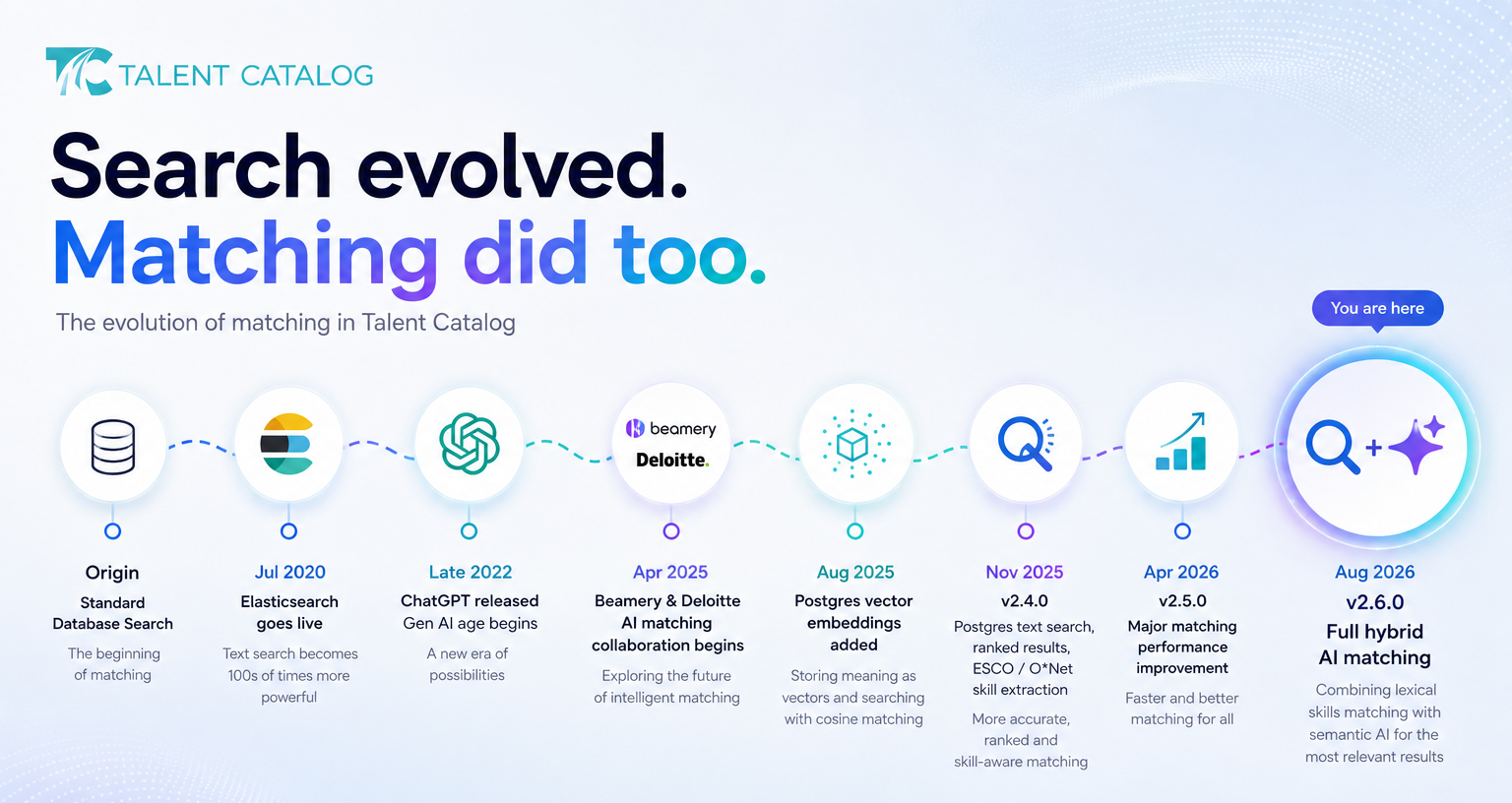
Matching has always been at the core of what Talent Catalog does, starting with our standard database search screen — the goal has always been to match a job description to candidates whose experience fits what’s described. The first major advance was Elasticsearch, which went live in July 2020 and made text search hundreds of times more efficient and powerful.
Then, in late 2022, ChatGPT arrived and the Generative AI age began. By April 2025 we were working with Beamery and Deloitte to explore AI matching, and in August 2025 we added AI vector embedding support to the Talent Catalog’s Postgres database. Vectors are at the core of all AI - in many ways they mimic the operation of neurons in the human brain, encoding the “meaning” of natural language text as numbers: multidimensional “vectors” that can be thought of as arrows pointing in directions in multidimensional space. Two pieces of text with similar meaning — say, a job description and a candidate’s job experience — translate into vectors pointing in roughly the same direction, and can be compared using a technique called cosine matching.
In November 2025, v2.4.0 moved matching off Elasticsearch entirely and onto Postgres text search, which also let us rank matches for the first time. That release also introduced automatic skill extraction from job descriptions, built on the world’s two largest skills databases, ESCO and O*Net. April 2026’s v2.5.0 then delivered a major performance improvement across all matching.
Behind the scenes, Talent Catalog now runs a hybrid matching engine that combines that lexical skills matching with “Beamery style” AI natural-language semantic matching — integrating with all of our existing traditional search capabilities into a flexible, fast, and economical hybrid matching capability. This release brings the first user-facing pieces of that engine online.
🔍 One Click From a Job Description to a Skill-Aware Search
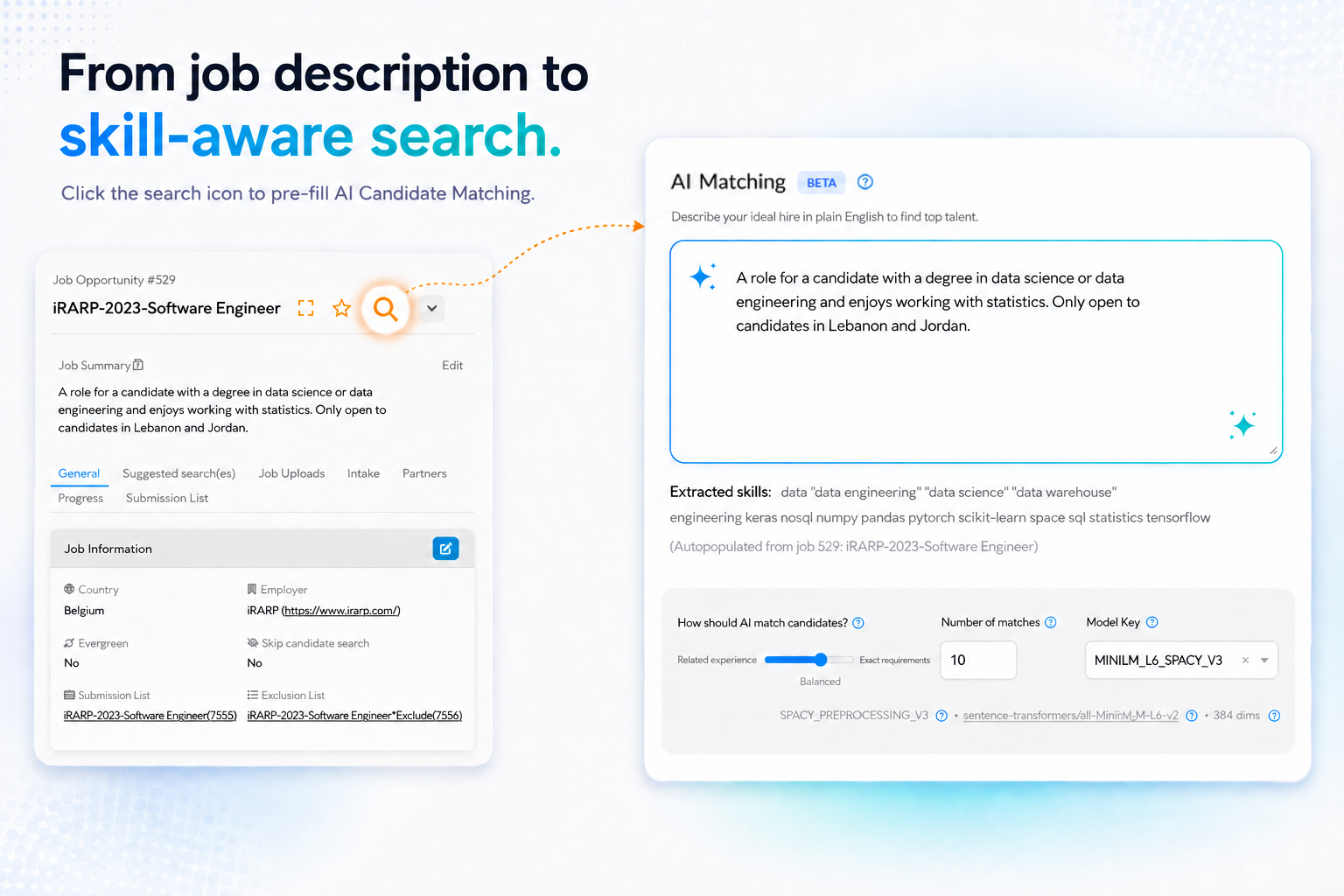
Clicking the search icon on a job pulls the skills mentioned in that job’s description and pre-populates the AI match requirements field on the New Search screen with them, along with a note showing which job they were extracted from. From there it’s an ordinary search that can be refined like any other — providing a powerful and general AI search capability, without taking away any existing search functionality. Eventually this kind of extraction is expected to happen automatically as part of the everyday job search flow, rather than needing the explicit click.
🎛️ Tuning an AI Search
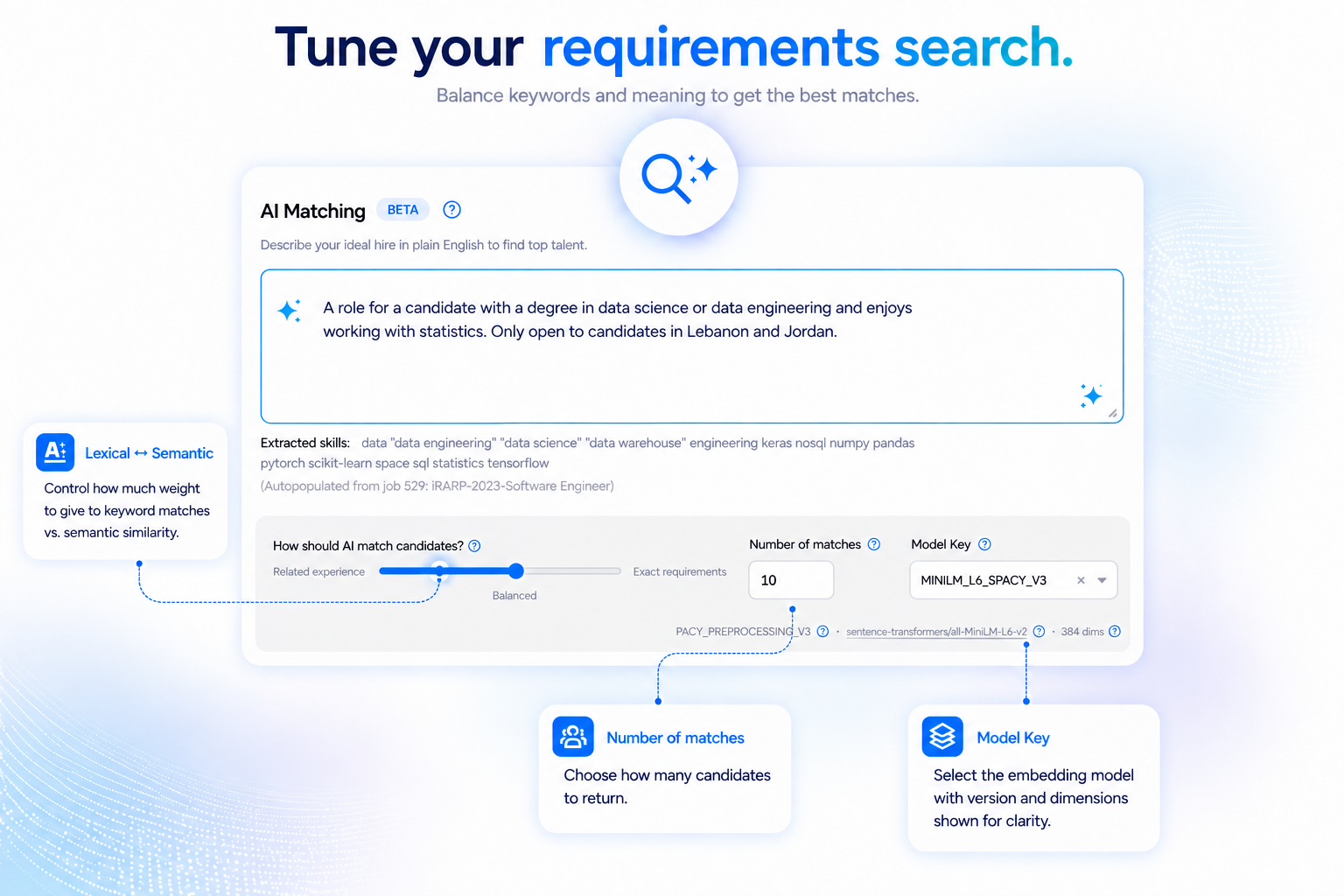
Whenever at least one embedding model is available, the New Search screen shows an AI match requirements field: free text describing the candidate experience being looked for — a job description, or anything similar. Once it’s filled in, three more controls appear:
- Lexical vs Semantic matching — a slider from 0 to 1 controlling how much weight is given to keyword matches in the AI match requirements text versus semantic similarity from vector embeddings. It defaults to 0.5, weighting the two equally.
- Number of matches — how many candidates to return, defaulting to the current page size.
- Model Key — which registered embedding model to match against, with its configuration version, name (linked to more detail), and vector dimensionality shown alongside.
📋 Search Within Any List
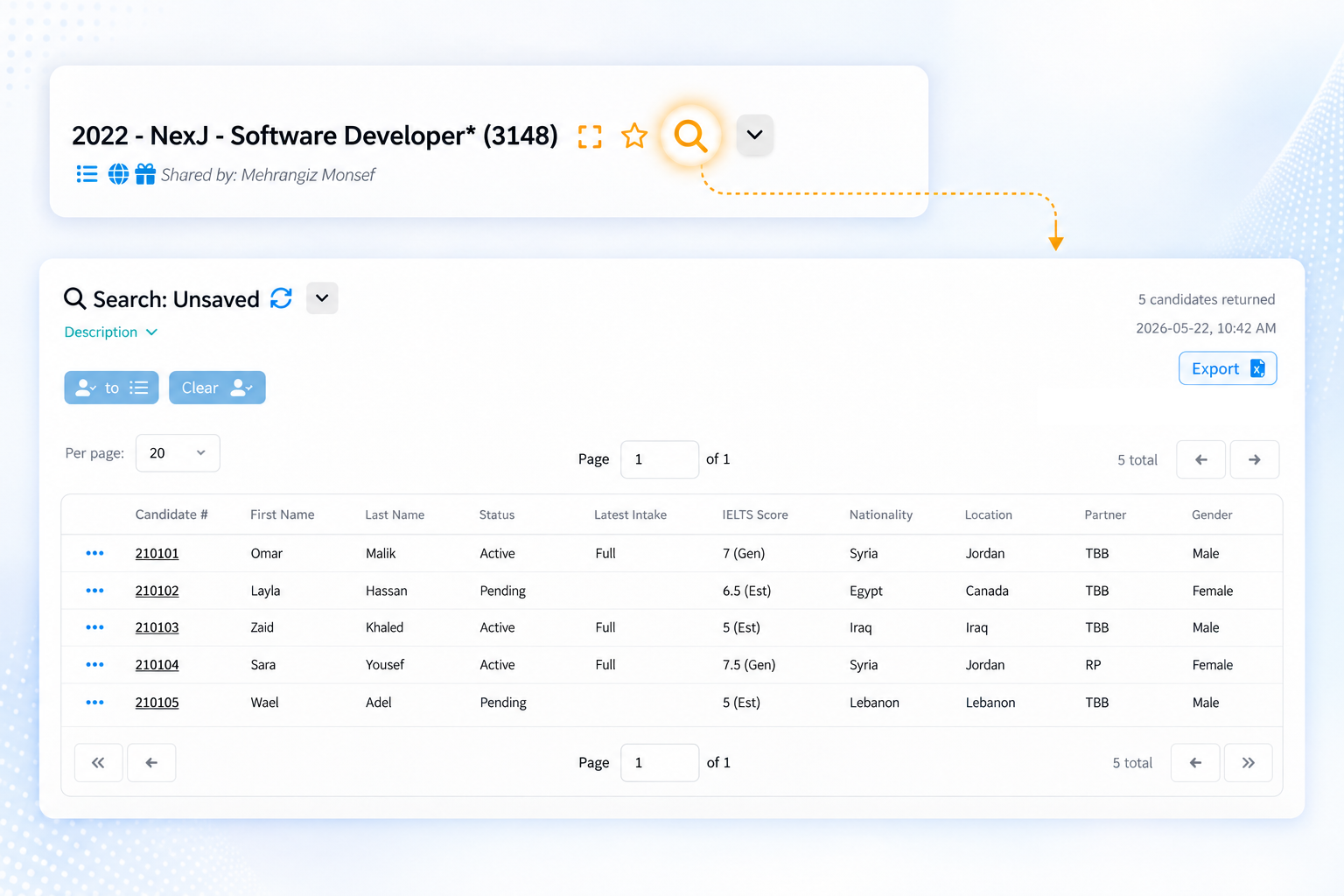
The same search icon now appears next to every list name. Clicking it opens the standard search screen pre-populated to show only candidates from that list — and from there, any other filter can be layered on top, including requirements based AI matching.
🎯 Full Search Filters Alongside AI Matching
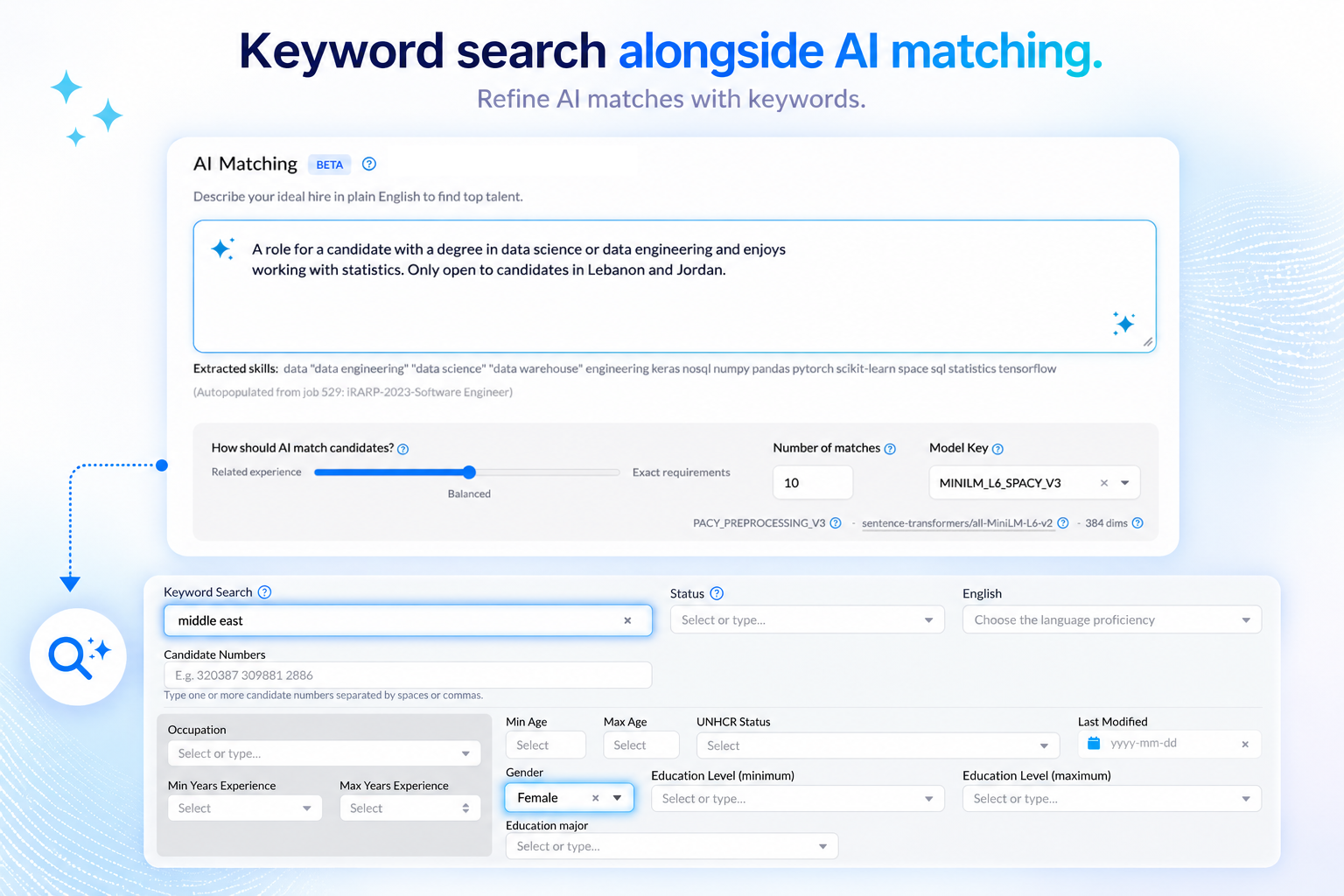
All the previous search and keyword filters, that you’re already used to using, can be applied as an additional filter on top of AI match requirements, so the two aren’t an either/or choice.
⚙️ Under the Hood: A Hybrid Matching Engine
This release also lays the backend groundwork for AI matching: a Postgres schema storing vector embeddings for candidate job experience, a process for building those embeddings for existing candidates, and query logic that blends lexical and semantic rankings according to the user’s configured weighting using the industry standard Reciprocal Rank Fusion (see notes below on RRF). Embedding models are pluggable — more than one can be registered, each with its own vector dimensionality — so the matching engine isn’t locked to a single provider or model going forward.
We’re starting with one of the most popular open-source models, all-MiniLM-L6-v2, but the architecture is designed to add and compare proprietary models too — from providers like Google, OpenAI, and Anthropic — as they prove out.
🔗 Useful Links
A Beginner’s Guide to Vector Embeddings
Introducing Reciprocal Rank Fusion for hybrid search
🚀 What’s Next
- Automatic skill extraction as part of the everyday job search flow, rather than needing an explicit click.
- Continued tuning of match quality based on real usage.
- Match explanations generated by LLMs (ChatGPT, Claude, Gemini, etc.), so users can see why a candidate was matched, not just that they were.